Learning materials
Remote sensing covers a broad spectrum: from physical and mathematical foundations to application-oriented analyses in the environmental sciences. This makes the topic well suited for interdisciplinary teaching. We develop learning modules for the school subjects mathematics, physics, computer science, geography and biology. The technical and physical foundations of remote sensing are covered in mathematics, physics and computer science. Processing and analysing remote sensing data is a subject of the application-oriented subjects geography and biology.
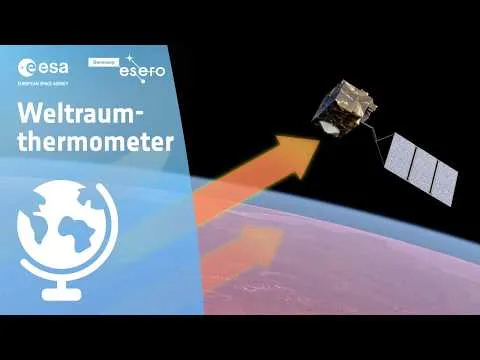
Space Thermometer
Measuring temperatures is something we do every day. But how do you measure the temperature of the entire Earth? This video introduces you to the Sentinel-3 satellite, our "thermometer in space." You’ll learn how it measures the Earth’s heat from 800 km above, and what we can learn from it. We’ll look at fascinating thermal images, like one from a heatwave in Egypt. You’ll see how cities, deserts, and forests have different temperatures. In the end, we’ll explain why these measurements are so important for understanding climate change and extreme weather events.
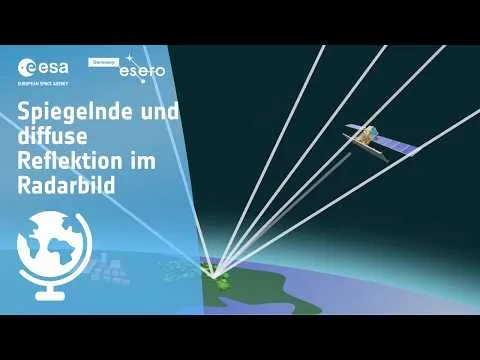
Specular and Diffuse Reflection in Radar Images
Light is reflected in a specific direction from smooth surfaces, while rough surfaces scatter it in many directions. Radar satellites use this principle for Earth observation. They send microwaves to the Earth and analyze the returning signals to identify different types of surfaces. Smooth surfaces appear differently on radar images compared to rough ones. By analyzing these differences, scientists can gather important information about the Earth’s surface. Stay tuned to learn more!
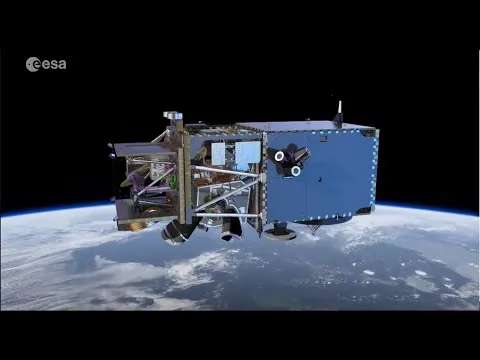
The Spectral Resolution
Spectral satellite sensors see the Earth as grey. This is because they record each wavelength range separately in what are known as spectral channels. Spectral resolution – that is, the number of spectral channels – is an important characteristic of satellite sensors. But what spectral resolution should a sensor have, and why can’t all regions of the electromagnetic spectrum be measured?